My old university asked me back to lecture on the future of consulting. The honest version is that the "scissors of death" are closing on advice-only work, faster now that AI has grabbed one of the blades, and what replaces it is a better job than the one it ends.
Not long ago Surrey, my old university, asked me back to lecture its business school on the future of consulting. I studied there, went on to train as a consultant, made partner in one of the big firms, and then co-founded a consulting venture builder, so I suppose I was a reasonable person to ask. I could have given the students the comfortable version: consulting is changing, learn some AI, keep your options open. Instead I gave them the honest one, and it has a name.
The scissors of death
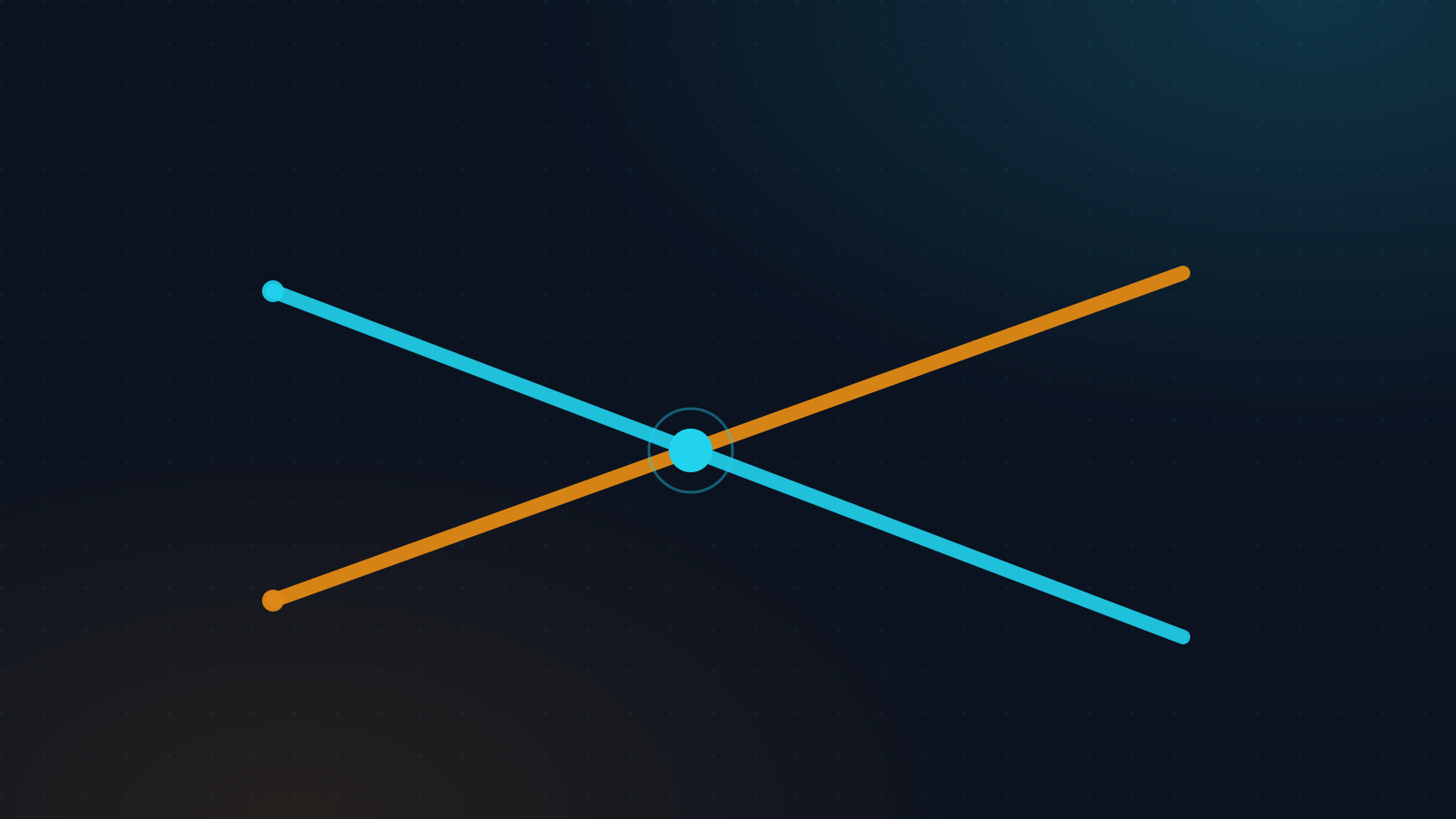
There is a phrase I learned early in consulting and have never forgotten: the scissors of death. Picture two blades. One is the cost of delivering good consulting, and it only ever rises: talented people, their salaries, the travel, the overhead of a firm built to sell hours. The other blade is the price a client will pay for advice, and over time it falls, because yesterday's rare insight becomes today's commodity. For decades the two blades stayed far enough apart that the model printed money. The scissors of death is the moment they close, the point where time-and-materials consulting, selling hours and a recommendation, simply stops making money.
For most of my career the blades were closing slowly, and you could stay ahead of them by moving upmarket into ever more senior advice, or by broadening the delivery pyramid with offshore teams. What has changed is that agentic AI has taken hold of the top blade and forced it down. When a client can get a credible first-cut analysis out of a model in an afternoon, the price of advice does not drift lower, it drops. The scissors that a generation of consultants gave their careers to stay ahead of now close inside a single planning cycle.
Cost to deliverPrice of advice
Two blades over time: the rising cost of delivery and the falling price of advice. Agentic AI slams them shut.
This is not new. AI just made it undeniable.
None of this should be a surprise, and I told the students so. Ten years ago Richard and Daniel Susskind wrote The Future of the Professions, and their argument has aged frighteningly well. They described the slow unbundling of expert work: the move away from bespoke service, the bypassing of the traditional gatekeepers who used to stand between you and an expert, and a relentless more-for-less pressure on everything the professions sell. Consulting spent a decade treating that as a thesis to debate at conferences. Agentic AI has turned it into this quarter's operating reality.
So the question is not whether consulting has a future. It is which part of it does.
What actually survives
Here is the part the doom headlines miss. The scissors close on advice-only work, the deck that ends at "here are our recommendations" and walks away. They do not close on outcomes. If anything, the value of a delivered, governed, working result rises exactly as the value of raw analysis falls, because the analysis is now the cheap part and the doing is the scarce and harder part.
I have written before about where the premium goes when this happens: to what I call deployment muscle, the ability to take an idea all the way into live operation and own what happens next. That is the heart of it. AI has not killed consulting. It has killed consulting without outcomes, and it has made the consultant who can actually build and run the thing more valuable than they have ever been.
This is why I am not gloomy about the profession, and did not leave the students gloomy either. The skills consulting builds, structured thinking, creativity, reading a room, writing with clarity under pressure, are exactly the skills you need to lead change in an AI-shaped organisation. They simply have to be pointed at a different end: not the recommendation, but the result.
A few rules I gave them
I closed the lecture with the rules I wish someone had handed me. A handful are worth repeating here, because they are really rules for anyone whose work is being repriced by AI, not just consultants.
01
You can't change the game
Big firms have a fixed model, and it will not change as fast as you can. Decide early whether you are reforming it or building alongside it.
02
Learn to love new skills
The half-life of what you know keeps shrinking. Treat learning as the job itself, not the thing you get to when there is time.
03
Your network is your net worth
When technical work commoditises, trust does not. It is the one asset an afternoon with a model cannot reproduce.
04
Make peace with failure
You will try things that have never been done in your organisation. The game is to learn faster than the scissors close.
Where you sit changes what you do next
If you are early in your career, do not build your identity around producing analysis. Build it around owning outcomes, and get as close as you can to the part of the work where a real result lands. If you are inside a firm, the rebuild is uncomfortable and unavoidable: it means changing what you charge for and how you staff before the market forces the change on you. And if you are a client who is tired of being handed beautiful decks that change nothing, this is your moment of leverage. Stop buying the analysis. Start buying the outcome, with a number on it and someone on the hook for it.
Your takeaway, right now
You do not need a five-year plan to get ahead of the scissors. You need one piece of real work that you own end to end. So here is the question I left the students with, and the one I would leave you with: what is the nearest thing on your desk that you could actually build and stand behind, rather than analyse and hand over?
Pick it, put a number on the outcome, and find the one place AI can do real work inside it. That is the future of consulting, in miniature, and the good news is that it is a better job than the one the scissors are closing on. If you want the map for making that shift, I have put the honest version into The New Consulting Transition Map.
Co-founder & COO at RAI Digital & Infinite PL · Ex-EY Consulting Partner · Writing on agentic AI, venture building, logistics platforms and transformation leadership.
One honest read every fortnight on what agentic AI is doing to consulting, and what to do about it. For people moving from advice to outcomes, rebuilding a firm, or done buying decks. No hype, no fluff.